Disclaimer: We’re writing this article from a warm-climate where boat diving is mandatory and there is no altitude diving, thus we’d suggest readers from other environments seek additional locally oriented information.
So, you’re now a qualified diver – Congratulations! (if not, go here)
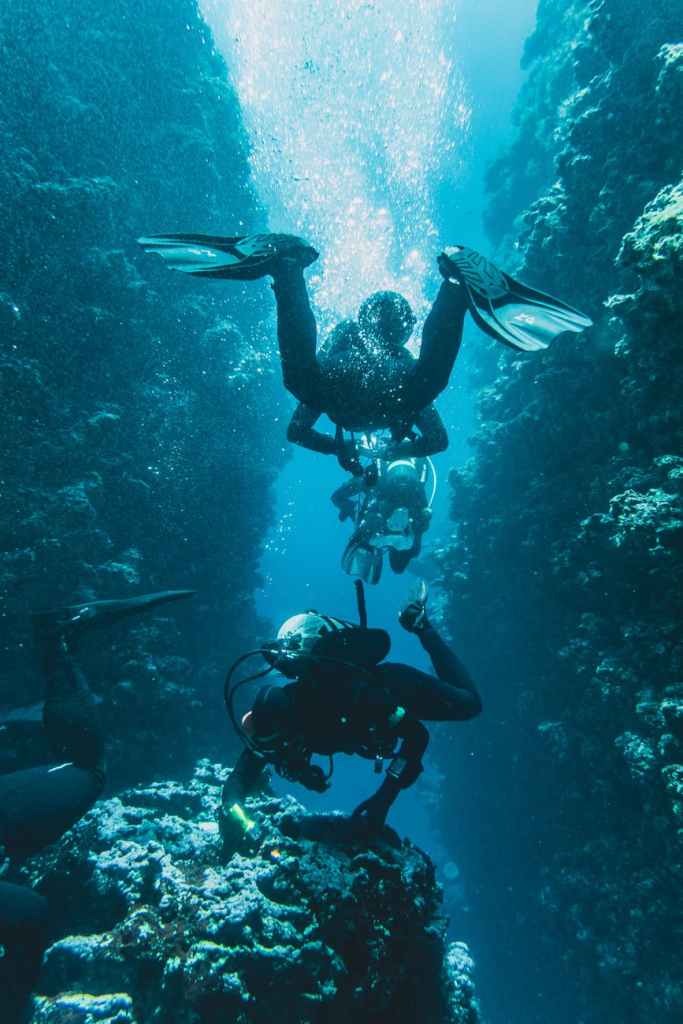
While you might not yet be in the category of 25-150+ dives with perfect buoyancy and awesome equipment (like the divers in the photo there), you have taken the first steps and started on an awesome path!
So, what’s next? Well, first, DIVE! Dive, dive, dive and dive, get some experience under your belt, get comfortable in the water and maybe invest in a little more gear (we highly recommend Dive Computers). After that, there’s a whole rabbit-warren of options to choose from (in addition to the bog-standard Open Water, Advanced, Rescue way of doing things).
Let’s start with our favourites, a great preparatory PADI Specialty course before going on to Advanced Open Water is the Peak Performance Buoyancy course, which is designed to give you a lot more knowledge and skill with regards to buoyancy control and weighting, hopefully getting you closer to the divers on the left there.
Peak Performance Buoyancy is a great primer that will get you more comfortable in the water before continuing your education (or just diving more).
From here you could take a look at PADI’s Digital Underwater Photography Specialty Course, or, if you’ve been bitten by an extra-strong diving bug, combine either Nitrox or Sidemount Specialty courses with your PADI Advanced Open Water Course.
And there we’ve said the magic words huh? PADI Advanced Open Water Course – 30 meters of depth rating, a Deep Adventure Dive, Navigation, more diver knowledge and experience and the chance to try out some really cool stuff including Underwater Photography, Search & Recovery and Nitrox in nice, bite-size experiences called Adventure Dives. The course itself is made up of 5 Adventure Dives, 3 of which are chosen by the diver and 2 of which are course-determined Deep Adventure Dive and Navigation Adventure Dives. In addition of course is knowledge development usually in the form of independent study via the Advanced Open Water Diver Manual or e-learning options. Unlike Open Water, there are no pool dives. A great, although little known fact about the Adventure Dives is that they’re in fact the first dive of each Specialty Course, so, as we said, a bite-size try dive for some amazing underwater activities that can be then credited across to your specialty qualification.
If we’ve excited you enough by this point, go diving then come back for our next article – the post-Advanced Open Water adventures! (soon to be published) Or Contact Us to discuss your next experience or course options.
(Above information is provided on an “at your own risk” basis. YOU are responsible for how you use the above information. By visiting this website you release authors/owners of TheDivingSource.com from any and all liability from any accidents, injuries or loss which may occur following your use of any information present on this website)
 The Diving Source